




-150x150.png)




Ethernet-APL brings native Ethernet connectivity down to field-level instrumentation, building on the IEEE 802.3cg 10BASE-T1L single-pair Ethernet standard. It's engineered specifically for the harsh conditions of process automation, including hazardous, potentially explosive areas where conventional networking equipment can't safely operate. By running data and power over one twisted-pair cable, Ethernet-APL replaces the parallel wiring runs traditional field networks require. Fewer cables mean simpler architecture, quicker commissioning, and a lower installed cost across large-scale plant deployments. None of that simplicity comes at the expense of performance. Ethernet-APL delivers full-duplex data rates of 10 Mbit/s over cable runs of up to 1,000 meters, more than 300 times faster than legacy fieldbus protocols like HART or Foundation Fieldbus H1, while still reaching distributed instruments across sprawling industrial sites. As the physical-layer foundation of the broader Single Pair Ethernet ecosystem, Ethernet-APL closes the long-standing gap between field instrumentation and enterprise IT systems, giving process plants a scalable, standards-based path to true field-to-cloud connectivity.
What Makes Ethernet-APL Essential for Industrial Networks
Simplified Two-Wire Design
One twisted-pair cable replaces bulky multi-wire runs, cutting material costs and slashing installation time across industrial network deployments.

Unified Power and Data Delivery
Ethernet-APL runs power and data over one twisted-pair cable, eliminating the need for dedicated power lines in industrial settings.

High-Speed Field Connectivity
Ethernet-APL delivers full-duplex data rates of up to 10 Mbit/s, over 300 times faster than legacy field communication protocols.
Extended Reach
Ethernet-APL maintains reliable communication across cable runs of up to 1,000 meters.

Explosion Protection
Built for hazardous environments, Ethernet-APL is engineered with explosion protection at its core.
How Does Ethernet-APL Differ From Single-Pair Ethernet?
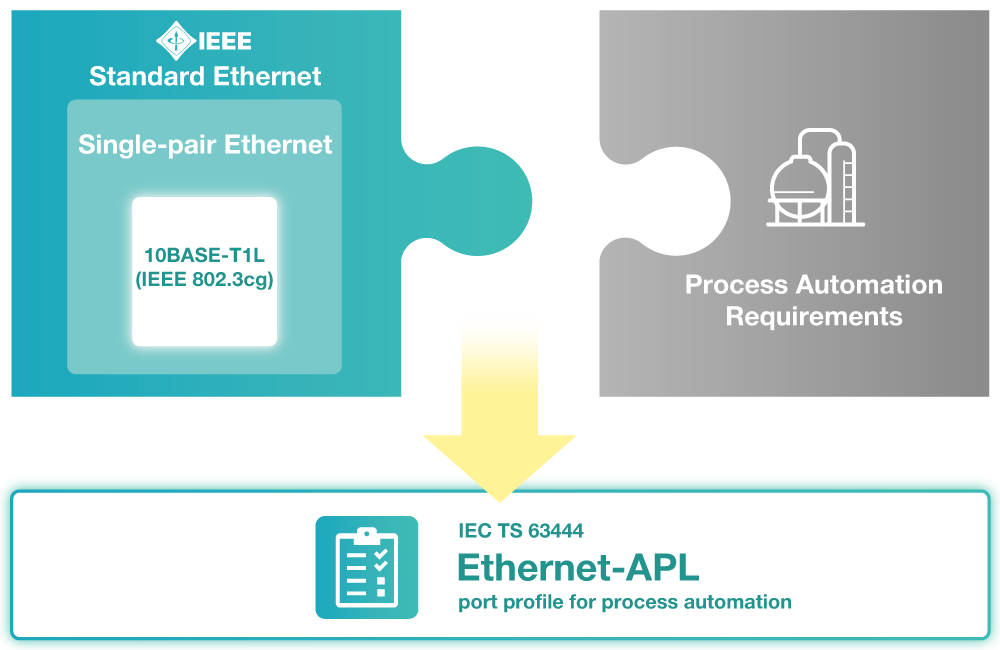
Ethernet-APL is a process-industry profile defined in IEC TS 63444:2023, built on top of the IEEE 802.3cg 10BASE-T1L single-pair Ethernet (SPE) standard to address the specific demands of process automation in sectors like oil and gas, chemicals, and pharmaceuticals. It brings field instruments directly onto Ethernet-based industrial networks through three core capabilities:
- Standardized Power Delivery: Delivers power and data simultaneously over one twisted-pair cable, using predefined port power classes for consistent, predictable device supply.
- Hazardous Area Protection: Built-in safety provisions support deployment in both intrinsically safe zones (Class I, Division 2, Zone 0/1) and non-intrinsically safe zones (Class I, Division 2, Zone 2).
- Streamlined Field Connectivity: Defines the electrical parameters, network topology, port classifications, and device roles needed for dependable field-level installations.
How Is Ethernet-APL Reshaping Industrial Networking?
Ethernet-APL pushes true Ethernet connectivity all the way to the field level, giving process plants a robust, reliable digital backbone that lifts operational efficiency across the board. Built-in explosion protection and safety-critical design make it a natural fit for hazardous industrial areas where standard networking gear simply can't operate. By standardizing on APL-compatible switches and field devices, plant operators can integrate instrumentation directly into their broader network architecture; streamlining processes while strengthening both productivity and safety on the plant floor. Ethernet-APL isn't just an incremental upgrade to field communication; it's a foundational shift toward smarter, safer, and more connected industrial operations.
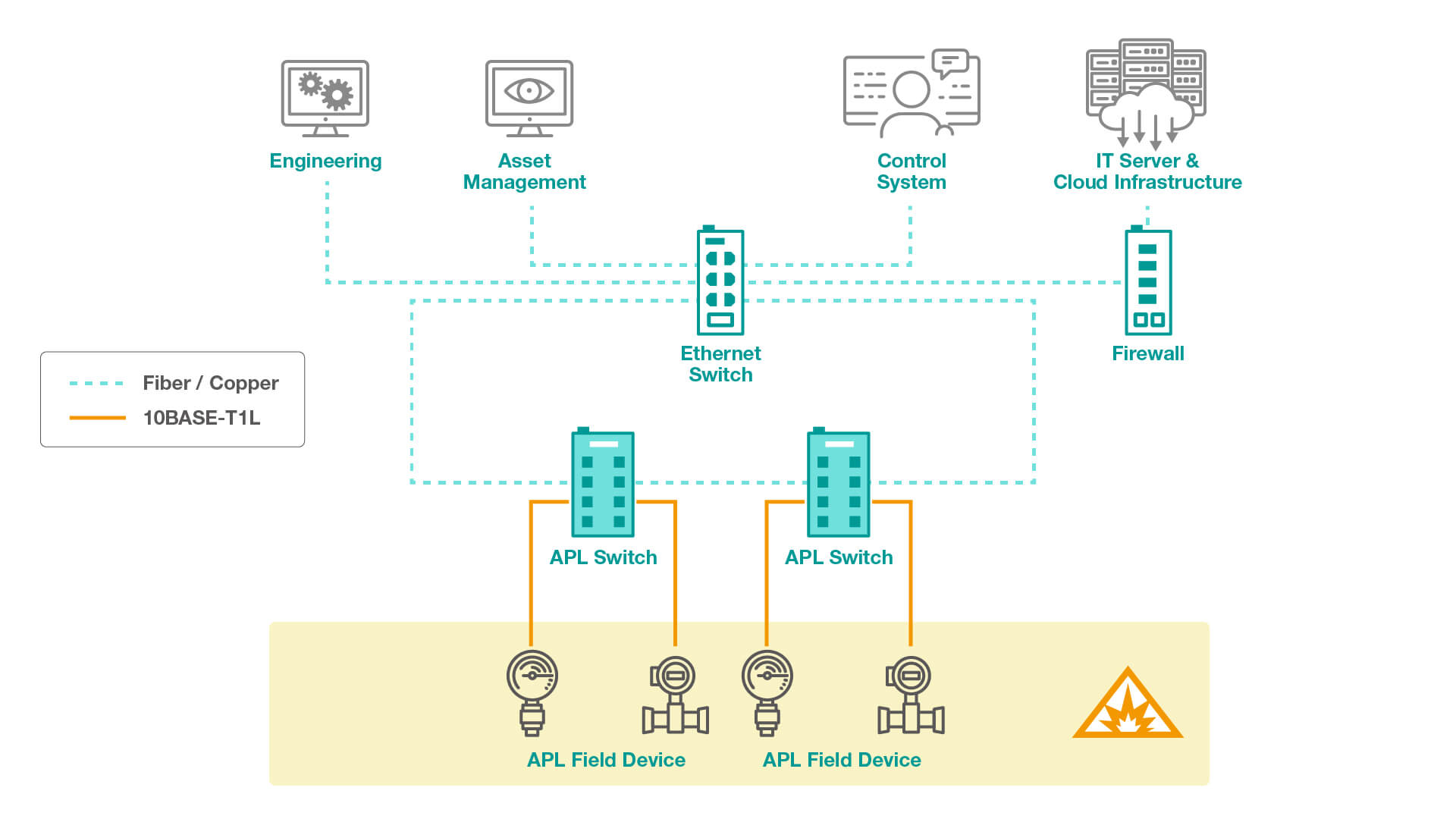
Ethernet-APL Applications
Process automation sits at the core of industries like oil and gas, mining, and chemical processing; sectors where intricate operations and demanding physical conditions call for networking infrastructure that's rugged, dependable, and built to perform. Ethernet-APL delivers a set of capabilities tailored precisely to these challenges. Here's how process automation in these sectors stands to benefit.

Requirements:
- Uninterrupted reliability to sustain 24/7 operations in harsh, hazardous environments.
- Support for large-scale, geographically dispersed installations.
- Continuous, real-time visibility into field-level monitoring and control processes.
Benefits of Ethernet-APL:
- Explosion Protection: Purpose-built for hazardous conditions, Ethernet-APL keeps operations safe in the explosive atmospheres common to oil and gas, mining, and chemical facilities.
- Long-Distance Connectivity: Cable runs of up to 1,000 meters let Ethernet-APL link scattered field devices across sprawling industrial sites without extra infrastructure.
- Real-Time Communication: Data rates of up to 10 Mbit/s give Ethernet-APL a sharper edge in data acquisition and control than legacy field protocols, sharpening decision-making and operational efficiency.
Frequently Asked Questions About Ethernet-APL
Ethernet-APL is changing the game for industrial communication, delivering reliable, high-speed data transmission over long distances even in the harshest operating conditions. This FAQ section covers the questions engineers and integrators ask most.
Because of its distinct physical layer, Ethernet-APL calls for purpose-built compatible hardware; APL field devices such as sensors and actuators, plus APL switches to handle network communication. These APL-capable components also remove the need for extra function-specific equipment, like gateways or field barriers between devices, simplifying the overall network infrastructure.
Traditional 4-20mA technology relies on point-to-point wiring and delivers only slow, analog data transmission; a real constraint as plant data needs grow. Ethernet-APL breaks past those limits with far faster data rates, flexible network topologies, and native compatibility with existing IT infrastructure. That combination makes it the stronger fit for modern industrial applications that demand real-time control, advanced analytics, and seamless interoperability across a diverse mix of devices and systems.
Traditional fieldbuses brought digital communication down to the field level, but they've long been held back by added complexity, lower data rates, limited scalability, and interoperability gaps that have slowed broader adoption. Ethernet-APL moves past these constraints by running standard Ethernet protocols directly at the field level, delivering higher data rates and cleaner integration across optimized protocol stacks. The result is a modernized approach to field-level connectivity, one that simplifies network architecture while raising the performance ceiling for industrial operations.
As a protocol-independent physical layer, Ethernet-APL provides a flexible foundation that supports multiple industrial Ethernet protocols, including PROFINET, EtherNet/IP, HART-IP, and OPC UA. Ethernet-APL itself doesn't handle application-layer compatibility, but standards organizations continue refining how these protocols map onto APL, ensuring they can take full advantage of the technology. That positions Ethernet-APL as a future-ready platform for interoperable, high-performance process automation networks.
Extending Ethernet to the Process Field With Moxa's APL Switch
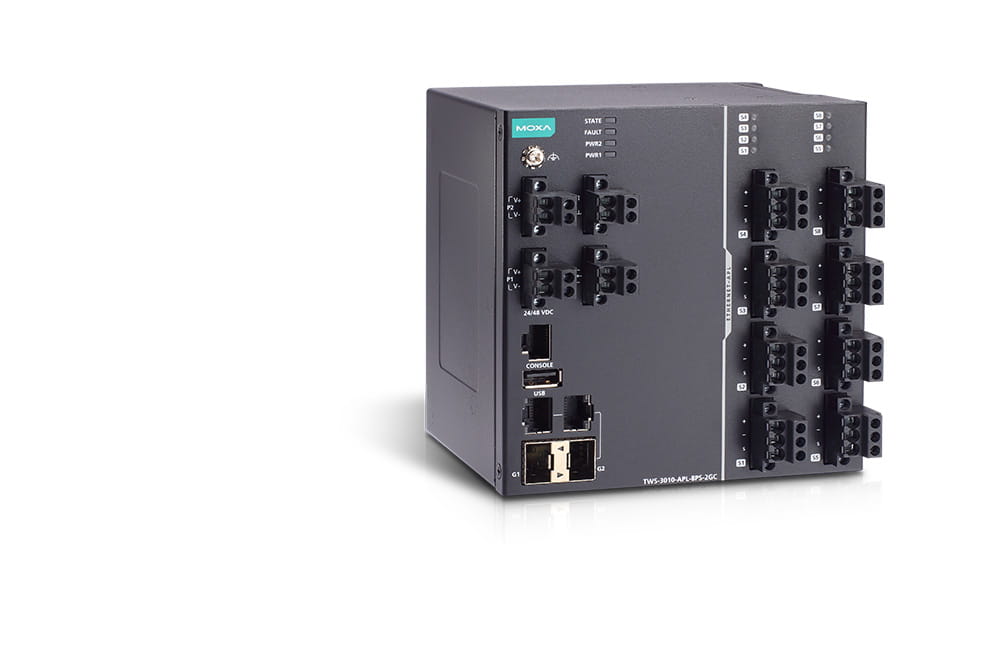
TWS-3010-APL Series
Managed Ethernet Switch with 8 10 Mbit/s APL Spur Ports and 2 Gigabit Uplink Ports
Features and Benefits
- 8 spur ports built on the 802.3cg 10BASE-T1L Ethernet-APL standard
- Power Class A and C support on every spur port for flexible field-device power delivery
- Compact form factor designed for space-constrained installations
- Built-in support for EtherNet/IP, PROFINET, and Modbus TCP industrial protocols
Related Products

/TWS-3010-APL%20Series/TWS-3010-APL-8PS-2GC-T/MOXA-TWS-3010-APL-8PS-2GC-T-Rockford-Communication-Solutions-300x300.jpg "MOXA TWS-3010-APL-8PS-2GC-T Two-Wire Ethernet Switch")
/TWS-3010-APL%20Series/TWS-3010-APL-8PS-2GC-T/MOXA-TWS-3010-APL-8PS-2GC-T-Front-Rockford-Communication-Solutions-300x300.jpg "MOXA TWS-3010-APL-8PS-2GC-T Two-Wire Ethernet Switch")
/TWS-3010-SPE%20Series/TWS-3010-SPE-8PB-2GC-T/MOXA-TWS-3010-SPE-8PB-2GC-T-Rockford-Communication-Solutions-300x300.jpg "MOXA TWS-3010-SPE-8PB-2GC-T Two-Wire Ethernet Switch")
/TWS-3010-SPE%20Series/TWS-3010-SPE-8PB-2GC-T/MOXA-TWS-3010-SPE-8PB-2GC-T-Front-Rockford-Communication-Solutions-300x300.jpg "MOXA TWS-3010-SPE-8PB-2GC-T Two-Wire Ethernet Switch")